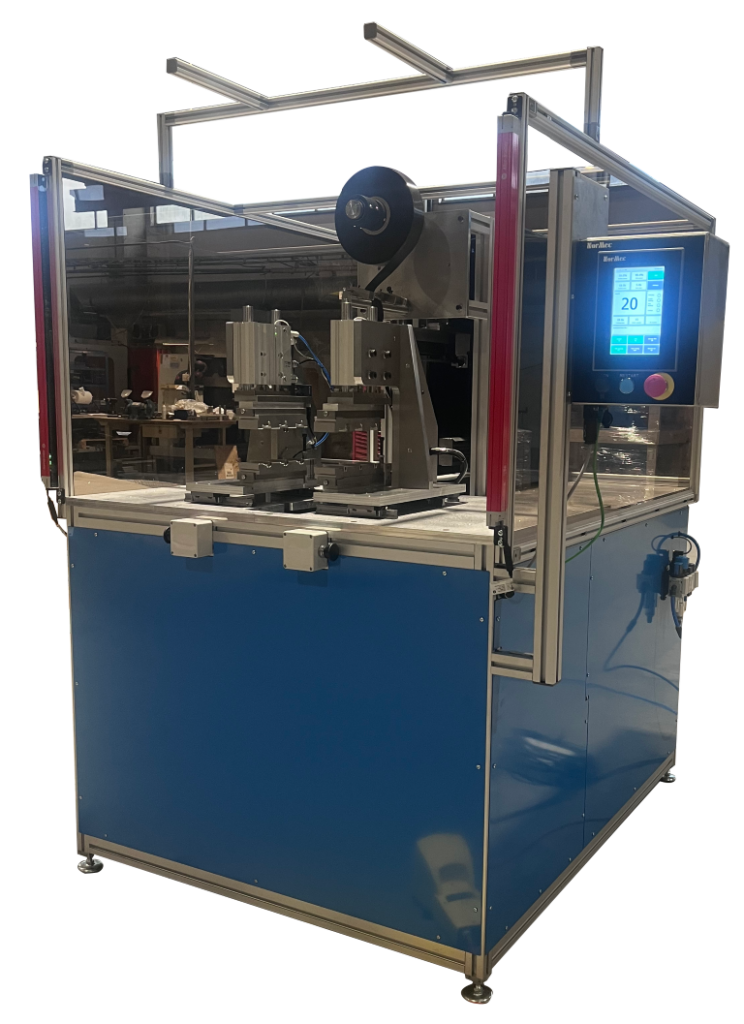
When a splice fails, the cost is rarely limited to one rejected part. It shows up as stoppages, rework, extra trimming, inconsistent quality checks and, in some cases, customer complaints that should never have left the factory. That is why an infrared rubber splicing machine has become a serious production asset for manufacturers working with rubber profiles, seals and gaskets where joint quality must be repeatable, not operator-dependent.
What an infrared rubber splicing machine actually does
At its core, an infrared rubber splicing machine uses controlled infrared heat to prepare and join rubber profile ends as part of a vulcanising process. The objective is not simply to stick two ends together. It is to create a strong, consistent splice with the right material flow, heat input and pressure, so the finished joint performs like the surrounding profile as closely as possible.
This matters because traditional joining methods can introduce too much variation. Gluing may appear simple, but it often depends heavily on surface condition, adhesive handling, curing behaviour and operator technique. Mechanical inconsistency in cutting and heating also creates weak points. Infrared splicing addresses those issues by delivering a more controlled thermal process at the joint.
For manufacturers processing EPDM that control can make the difference between a splice that passes inspection and one that fails in use. The machine is not working in isolation either. Splice quality is shaped by the full process, including cutting accuracy, profile positioning, heat exposure, pressure application and film or mould selection where relevant.
Why infrared heating improves splice consistency
The key advantage of infrared heating is precision. Instead of applying heat in a broad, less targeted way, infrared technology allows the splice zone to be heated quickly and with greater control. That reduces unnecessary thermal stress on the surrounding material while bringing the joint area to the required condition for a reliable bond.
In production terms, that usually leads to three practical gains. First, cycle times can be shortened because the heat is delivered efficiently. Second, the splice area is more uniform from one part to the next. Third, post-processing is often reduced because there is less excess material distortion and less variation in the finished joint.
That said, infrared is not a shortcut around process discipline. If profile ends are poorly cut, if material batches vary significantly, or if tooling is mismatched to the geometry, even a well-designed machine will not compensate for every upstream problem. The best results come when infrared heating is part of a defined and repeatable method rather than a standalone feature.
Where an infrared rubber splicing machine fits in production
In most workshops and industrial production environments, the machine sits within a wider splicing workflow. Profiles are cut to the correct angle or shape, prepared for joining, aligned in tooling or moulds, heated at the splice interface, and then pressed or vulcanised under controlled conditions. The machine therefore supports both quality control and throughput.
For production managers, the value is usually measured in fewer rejected joints, more predictable output and reduced dependence on individual operator judgement. For engineers, the value is process stability. For procurement teams, the value is longer-term – lower scrap, fewer warranty issues and a machine platform that can handle recurring production demands without introducing unnecessary complexity.
This is particularly relevant in operations producing closed-frame seals, joined profile rings and fabricated rubber components where every splice has to meet dimensional and mechanical expectations. A weak splice is not just a local defect. It can undermine the function of the complete part.
Choosing the right infrared rubber splicing machine
Not every infrared rubber splicing machine suits every production environment. The correct choice depends on what you are producing, the materials involved, your batch sizes and the level of repeatability you need.
Material compatibility is one of the first considerations. EPDM behaves differently from silicone, and both differ again from NBR or natural rubber. Heat response, cure behaviour and surface characteristics all affect the joining process. A machine should support stable processing across the materials you actually run, not only under ideal test conditions.
Profile geometry matters just as much. Small, simple sections may run well with a relatively standard setup, but complex shapes often require carefully developed moulds, accurate clamping and precise heat management. If your production includes a wide range of profiles, versatility becomes more valuable. If you run a narrow product range at higher volume, optimising the machine for repeat production may deliver better returns.
You should also look closely at operator usability. In many factories, a technically capable machine still underperforms because setup is too sensitive or adjustments are too time-consuming. Clear controls, repeatable settings and straightforward maintenance all contribute to output quality. A machine that is slightly more sophisticated but easier to run consistently is often the better investment.
Process factors that affect splice quality
Even with advanced equipment, the splice result depends on several connected variables. Heat input has to be correct, but so do pressure, timing and alignment. If one of those drifts, the finished splice may show weak bonding, poor appearance or excess flash.
Cut quality is a common source of inconsistency. If profile ends are not cut cleanly and accurately, the joint interface becomes uneven before heating even begins. Tooling condition also matters. Worn or unsuitable moulds can create dimensional variation and force operators to compensate manually, which usually introduces more inconsistency rather than less.
Consumables are another factor. In hot film vulcanising systems, film quality and selection influence bond performance. Using the wrong film or applying it inconsistently can undermine the benefits of the machine itself. That is why experienced manufacturers tend to evaluate the process as a complete system rather than treating the splicing machine as the only variable.
Expected gains and realistic trade-offs
A well-specified infrared splicing process can improve splice strength, shorten cycle times and reduce scrap. It can also help standardise production across shifts, which is often one of the less visible but more valuable gains. When settings are stable and process windows are clear, output becomes less dependent on who is operating the machine.
The trade-off is that better control usually requires a more disciplined setup. Infrared technology rewards consistency in preparation and machine calibration. Businesses expecting immediate improvement without reviewing tooling, material handling or operator training may be disappointed.
There is also the question of volume. For high-frequency splicing operations, the gains in throughput and reduced waste can justify investment quickly. For lower-volume or highly varied workshop work, the value may come more from quality improvement and lower rework than from headline speed. It depends on where your current losses sit.
Why process expertise matters as much as machine design
An infrared rubber splicing machine is only as effective as the process knowledge behind it. That includes understanding how different compounds respond to heat, how profile design affects the joint, and how to balance productivity with splice integrity.
This is where specialist manufacturers stand apart from general equipment suppliers. A machine built around proven splicing methods, developed over years of production use, tends to deliver stronger results than equipment sold on specification sheets alone. In practice, repeatable splicing depends on machine design, tooling, consumables and application knowledge working together.
For that reason, many buyers now look beyond nominal machine features and focus on process outcome. They want to know whether the system reduces failure rates, whether it supports the compounds they use, and whether it can maintain quality under everyday factory conditions. That is the right approach. Performance on the shop floor matters more than technical claims in isolation.
NorMec has built its position on that principle – combining machine development with a defined splicing method aimed at stronger joints, better repeatability and more efficient rubber profile production.
What to ask before investing
Before selecting a machine, it is worth reviewing a few practical points internally. What are your current splice failure modes? Are you losing time in heating, trimming or rework? Do you need flexibility across many profiles, or maximum efficiency on a smaller number of parts? And are your material and tooling standards already stable enough to take full advantage of a controlled infrared process?
Those questions often reveal whether the main need is higher output, better splice strength, reduced operator variation or a combination of all three. They also help define whether you need a standalone machine or a broader process setup that includes cutting, moulding and consumables.
A good infrared splicing system should not make your operation more complicated. It should make quality easier to repeat. If the process is properly matched to your materials and production requirements, the result is not only a better splice. It is a more dependable production line.