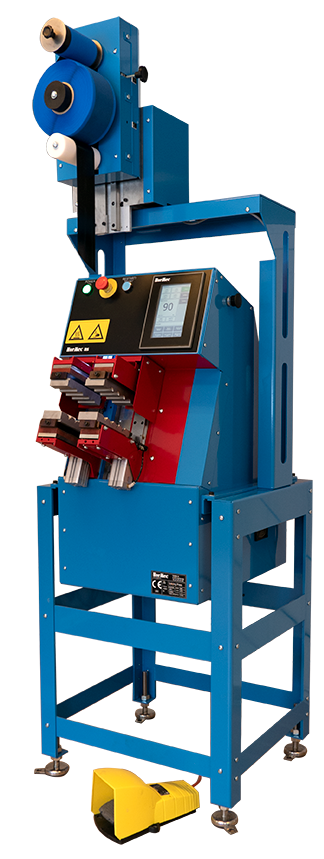
A poor splice rarely fails on the press. It fails later – during handling, post-processing, fitting or service life. That is why a rubber profile splicing press matters so much in profile production. It does more than apply heat and pressure. It controls a joining process that directly affects strength, geometry, appearance, scrap rate and throughput.
For manufacturers producing seals, gaskets and technical rubber profiles, the splice is often the most vulnerable point in the finished part. If the joining method is inconsistent, every downstream stage becomes harder to manage. Operators spend more time correcting parts, reject rates rise, and delivery performance starts to suffer. A well-designed press addresses those issues by making the splice repeatable.
What a rubber profile splicing press actually does
At a basic level, a splicing press joins two cut ends of a rubber profile under controlled heat, pressure and time. In industrial production, that control is the difference between a cosmetic bond and a structural splice. The press keeps the profile aligned, holds the material in the correct position, and applies the process conditions needed for hot vulcanisation.
That sounds straightforward, but in practice the machine must cope with variation in profile geometry, rubber compound behaviour and production pace. EPDM does not respond in exactly the same way as silicone. A compact profile does not behave like a large hollow section. Even the way the profile is cut and presented to the tooling can influence the final result. A proper splicing press is designed around that reality.
When the machine, tooling and joining method are matched correctly, the splice can achieve high strength with a clean finish and minimal rework. That is the result most production teams are looking for – not simply a closed ring, but a join that performs like the surrounding material as far as possible.
Why process control matters more than raw force
Buyers sometimes focus first on press force or heating power. Both matter, but neither tells the whole story. In profile splicing, control is usually more important than maximum output from any single component.
The key variables are temperature stability, pressure distribution, dwell time and positioning accuracy. If temperature fluctuates, the rubber may under-cure or over-cure at the joint. If pressure is uneven, the splice line may be weak on one side and flash heavily on the other. If timing depends too much on operator judgement, consistency becomes difficult across shifts.
This is where dedicated equipment outperforms improvised or older joining setups. A purpose-built splicing press gives repeatable conditions from one cycle to the next. That improves not only bond quality but also predictability. Production managers can plan output with more confidence when the machine produces the same result at the start of the shift as it does near the end.
Rubber profile splicing press performance depends on the whole method
The press is central, but it is only one part of the splicing system. Profile preparation, cutting accuracy, film or joining material, mould design and operator handling all influence the finished splice. If one part of the chain is weak, the press alone cannot compensate for it.
That is why experienced manufacturers do not assess a rubber profile splicing press in isolation. They look at the complete production method. The most effective systems are built around a defined process where the press, the tooling and the joining material are designed to work together.
Hot film vulcanising is a good example of this. Compared with older gluing methods, it offers greater control over bond formation and durability. In the right setup, it can reduce weak joins, improve visual consistency and cut post-finishing time. That process thinking has been central to modern industrial splicing development for years, because it solves production problems at source rather than after the event.
Where quality gains show up on the factory floor
The value of a better splicing press is rarely limited to the splice station itself. The gains show up across the line.
First, reject rates usually fall when the joining process becomes more stable. Fewer open joints, fewer dimensional problems and fewer visual defects mean less wasted material. That matters especially where compounds are costly or part volumes are high.
Second, post-processing becomes easier. If the splice comes out cleaner, operators spend less time trimming, grinding or correcting shape. This shortens cycle time in a way that is often underestimated during equipment evaluation.
Third, production flow improves. A reliable splice process reduces interruptions caused by trial-and-error adjustments. Operators are not repeatedly stopping to compensate for inconsistent temperature, pressure or fit-up. Over time, that stability has a direct effect on throughput.
There is also a quality assurance benefit. A repeatable machine process makes it easier to standardise work instructions, train new staff and maintain consistent output across operators. For plants managing multiple profile types, that is a practical advantage rather than a theoretical one.
What to look for when choosing a splicing press
The right machine depends on your profile range, compounds, volumes and required finish. There is no universal answer, but a few technical questions usually separate suitable equipment from equipment that only appears suitable.
Start with profile compatibility. The press and mould setup should match the cross-sections you actually produce, not only the simplest examples. If your mix includes corner joints, larger profiles or more demanding compounds, the machine needs to handle those conditions without becoming slow or inconsistent.
Then consider thermal control. Stable, accurately regulated heat is essential for repeatable vulcanisation. Fast heating is useful, but not if it comes at the expense of even temperature across the splice area.
Tooling matters just as much. The mould must support alignment, control flash and maintain geometry through the cycle. Poor tooling can turn a capable press into an unreliable process.
Ease of operation also deserves attention. In a busy production environment, complicated adjustment routines create variation. Machines designed for practical workshop use tend to produce better long-run results because they reduce operator dependency.
Finally, look beyond the machine specification and ask whether the supplier understands the joining process itself. That experience can make a significant difference during installation, commissioning and optimisation.
Different materials, different behaviours
One reason rubber profile splicing is rarely simple is that compounds respond differently under heat and pressure. EPDM, NBR, SBR, CR, NR and silicone each bring their own processing behaviour. Cure response, surface characteristics, elasticity and thermal tolerance all affect splice quality.
That means the best press settings for one material may be wrong for another. Even within the same material family, compound formulation can alter the result. A production team that switches frequently between compounds needs a press that supports controlled adjustment rather than fixed assumptions.
This is also where proven process expertise becomes valuable. Decades of application work tend to reveal the small factors that cause large quality differences – how the cut behaves under pressure, how much film is needed, how the mould supports the profile, and where overheating starts to show. Those details are difficult to replace with guesswork.
Why older joining methods often become the bottleneck
Some manufacturers still rely on methods that were acceptable when output demands were lower and quality expectations were less strict. The problem is not simply that those methods are old. It is that they often leave too much to manual judgement.
Glued joints, for example, can work in certain applications, but they usually offer less process control and less durability than a properly managed hot vulcanised splice. Where parts are handled intensively or expected to perform over time, that difference becomes more visible.
As production volumes rise, the limitations become sharper. Variation increases, inspection workload grows and rework absorbs labour that should be spent on output. At that point, the splice process is no longer a small technical step. It is a production bottleneck.
A specialised supplier with a defined approach to rubber joining can remove that bottleneck. NorMec has built its equipment development around exactly that challenge, combining press design with an established splicing method developed for industrial repeatability.
The better question is not “Do we need a press?”
For most profile manufacturers, the better question is whether the current joining process gives enough control for the quality level and output speed the business now needs. If the answer is no, a rubber profile splicing press is not just another machine purchase. It is a way to standardise one of the most failure-sensitive points in production.
The strongest investment cases are usually built on reduced waste, fewer failures and less manual correction rather than headline cycle speed alone. Speed matters, but dependable quality at production pace matters more. When the splice is right first time, the rest of the operation tends to run better too.
If you are reviewing your joining process, start with the splice defects that cost the most time and money. The right press should not merely mask them. It should give you the control to prevent them.